

A New York founder sits across from two agencies in the same week. Both promise authority. Both show polished decks. Both talk about visibility. The first agency walks through a content calendar. The second shows a follower growth chart. Both meetings run exactly forty-five minutes. Both end with a proposal offer.
The founder leaves both meetings with the same question. Who actually understands how to build a personal brand that drives real demand?
She goes back to her desk and searches “top personal branding agencies New York.” Three articles appear. They name roughly the same agencies. None of them explain why one agency might be right for a B2B founder and wrong for a corporate executive in transition. None of them mention pricing. None of them describe a process in enough detail to be useful. They read like they were written for an algorithm, not a buyer.
That is the problem this article is trying to solve.
This is written for founders, executives, consultants, and creators who are actively considering hiring a personal branding agency in New York, who have done preliminary research and found it unhelpful, and who want a sharper framework for making a confident decision. It is not a promotional ranking. It is an evaluation guide that happens to include a shortlist.
Most lists in this space fail the buyer before the first agency name appears. The failure is structural.
No evaluation criteria. A ranked list without criteria is just a sequence of names. It tells a buyer nothing about why agency A is listed above agency B, what situation each agency is built for, or how a specific buyer should weight one option against another. Without criteria, ranking is decoration.
The same recycled agency names. Search for “best personal branding agency NYC” and you will find the same five or six names appearing across articles that clearly reference each other. Those names appear not because they were independently verified but because they were already there. A name that appears in many lists has strong SEO. That is not the same as consistent results.
No clarity on who each agency is right for. A founder building a thought leadership presence to attract investors has different needs than a C-suite executive trying to establish credibility in a new industry. A consultant generating leads through content operates in a different context than a first-time author building a public profile. Useful lists separate these situations. Generic lists do not.
No honest discussion of pricing or engagement depth. Personal branding services in New York range from a few hundred dollars for a LinkedIn profile rewrite to fifty thousand dollars and above for a full strategic positioning engagement. A buyer cannot make a rational decision without some understanding of where an agency sits on that spectrum. Most lists skip this entirely, leaving readers to discover it only after a sales call.
Focus on visibility instead of business outcomes. The question a serious buyer needs answered is not “how many followers will I have?” It is “what will change commercially because of this investment?” If a list does not engage with that distinction, it is not written for serious buyers.
Capable agencies exist in New York. Agencies that operate at a genuinely high level are fewer. The difference is not in effort or execution speed. It is in how they think.
Strategic positioning versus content execution. A capable agency can produce consistent, well-written content. A top agency builds the strategic foundation that makes content worth creating: who you are positioned for, what you want to be known for, why someone should believe it, and how that positioning differentiates you from others in your category. Without that foundation, content is activity, not strategy.
How to verify it before hiring: Ask the agency to describe their positioning process before any content is written. If they begin with tone of voice and content formats rather than audience definition and message architecture, they are executing without a strategic foundation.
Founder narrative building versus generic messaging. The best personal branding work is specific to the person. It draws from their actual history, their particular point of view, their language, their experiences. It reads unmistakably like them. Generic messaging applies a structure that fits anyone. It is competent, consistent, and completely forgettable. The test is whether the content could belong to someone else with minimal editing.
How to verify it before hiring: Ask to see two or three client profiles or content samples. Read them against each other. If the voice, the structure, and the opening lines feel interchangeable, the agency is applying a template.
Distribution systems versus isolated posting. Many personal branding agencies think primarily about one platform. Top agencies think about where a specific client’s target audience actually spends attention, how to build credibility across multiple touchpoints, and how to connect platform activity to inbound pipeline. Publishing three LinkedIn posts a week is not a strategy. It is a routine.
How to verify it before hiring: Ask directly what a distribution strategy looks like beyond content creation. If the answer stays inside one platform or focuses primarily on frequency, the thinking is limited.
Demand generation versus vanity metrics. An executive brand exists to make the right conversations easier to start, the right deals easier to close, and the right invitations easier to receive. Those are commercial outcomes. Follower counts, impressions, and likes are data points. They become meaningful only when they connect to business results. Agencies that lead with reach numbers are optimising for a metric that is easy to measure, not one that matters most.
How to verify it before hiring: Ask for a specific case study where a client can point to a business outcome they attribute to their personal branding work. Specificity in the answer signals that the agency thinks in terms of outcomes. Vagueness signals that they do not.
ICP clarity and message sharpness. The most consistent failure in personal branding is attempting to reach everyone. A message designed for a broad audience lands with no one specifically. The best agencies push clients toward precise audience definition and help them resist the instinct to stay broad. That precision is what makes a personal brand commercially functional rather than simply visible.
How to verify it before hiring: Ask the agency to describe the most tightly defined audience targeting they have built for a client. An agency that thinks in specifics will answer specifically. An agency that thinks in generalities will answer with generalities.
The following patterns appear consistently in agencies that underdeliver. They are worth knowing before any sales conversation begins.
Obsession with posting frequency over positioning clarity. When the first conversation focuses on content calendars, posting schedules, and platform cadence rather than positioning questions, the agency is treating output as the deliverable. Output without strategy is noise at scale. The right first question from any agency should concern what you want to be known for and why someone should believe it.
No defined framework or repeatable process. Ask any agency to describe their onboarding and delivery process from start to finish. A credible agency can articulate this clearly because they have done it enough times to understand what sequence of thinking produces consistent results. If the answer relies heavily on intuition, personality, or creative feel, the work is not systematised. Good work can still come from unsystematised processes. Consistent, repeatable results rarely do.
Unrealistic growth timelines. Any agency that offers specific follower counts or reach targets within a defined period is making a promise about variables they do not control. Platform algorithms, posting frequency, audience behaviour, and content resonance all interact in ways no agency can fully predict. Guarantees about growth speed exist to close contracts. They do not reflect how audience-building actually works.
Weak or irrelevant client examples. Look at the case studies carefully. Is the client content specific to that person, or does it feel like it was produced with a template? Are there measurable outcomes mentioned, or only qualitative praise? Does the client type resemble your situation, or is the portfolio built around an audience that shares nothing with yours? The strongest case study is one where the result is specific and the client situation resembles your own.
Messaging that sounds the same across industries. Pull several client profiles from the same agency and read them alongside each other. If the structural patterns, the opening line formats, and the narrative arcs are consistent across a software founder, a finance executive, and a management consultant, the agency is not building individual narratives. They are applying a fill-in-the-blanks system. The outputs may be polished. They will not be distinctive.
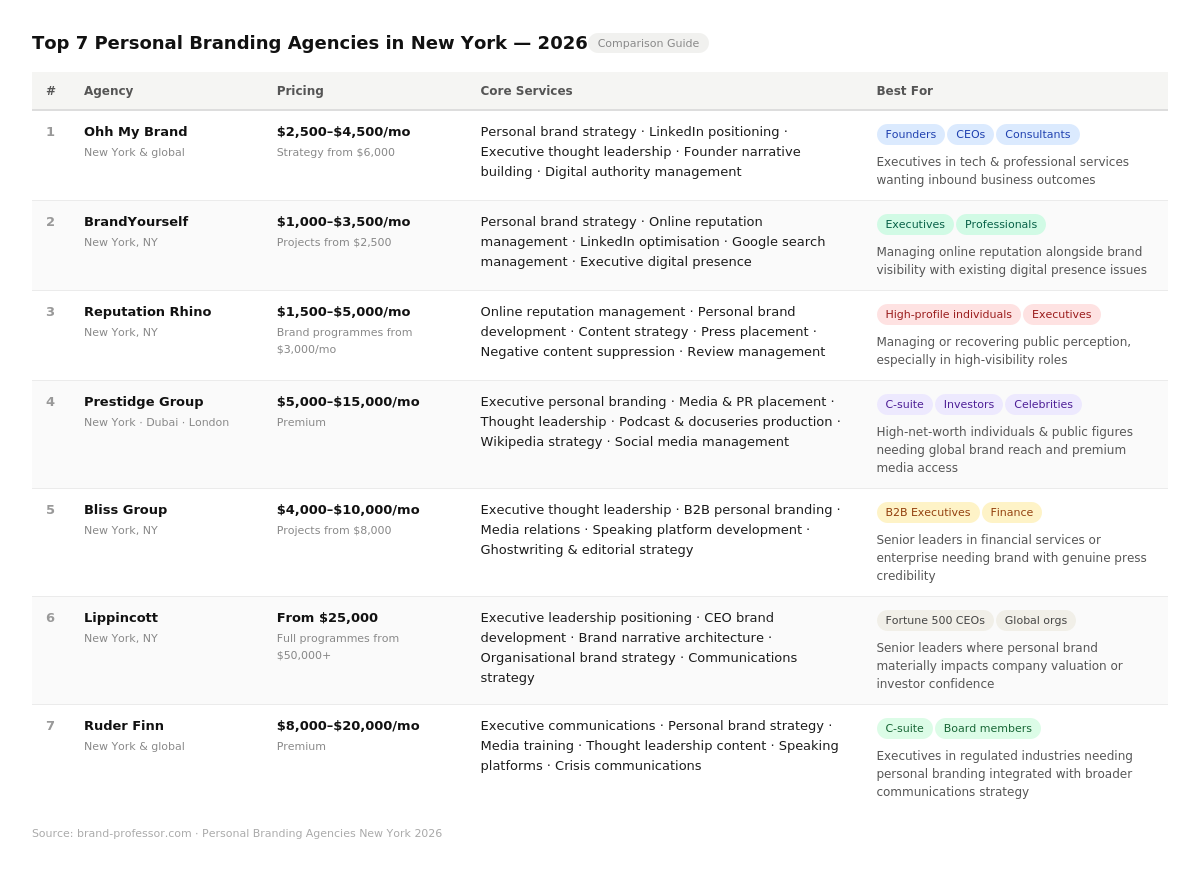
This shortlist was built around service depth, documented process, and genuine relevance to senior professionals and founders. It is not exhaustive. It is a starting point for a more informed conversation.
Location: Serving New York and major global business markets, with international client delivery
Founded: 2015
Team size and structure: Focused core team of brand strategists, narrative writers, and digital distribution specialists, structured around individual client engagements
Core services: Personal brand strategy, LinkedIn positioning and content, executive thought leadership development, founder narrative building, digital authority and reputation management
Notable client types: Founders, CEOs, senior consultants, and executives across technology, professional services, and entrepreneurship
Pricing range: Mid to premium. Monthly engagements typically from $2,500 to $4,500; strategic positioning projects from $6,000 upwards
Key differentiator: Ohh My Brand approaches personal branding as a positioning problem before a content problem. The agency builds the strategic foundation first, including audience definition, message architecture, and narrative framework, before any content is produced. This sequencing makes the work specific to each client rather than templated. It is a strong fit for founders and executives who want their personal brand to generate inbound business outcomes. It is not suited to individuals looking for fast content output without engaging in the underlying strategic work.
Location: New York, NY
Founded: 2009
Team size and structure: Mid-sized team combining brand strategists, SEO specialists, content creators, and online reputation managers
Core services: Personal brand strategy, online reputation management, LinkedIn optimisation, Google search result management, executive digital presence building
Notable client types: Executives, professionals, and entrepreneurs managing online reputation alongside brand visibility, particularly those with existing digital presence issues
Pricing range: Managed service packages from approximately $1,000 to $3,500 per month depending on scope; project-based work from $2,500
Key differentiator: BrandYourself operates at the intersection of personal branding and online reputation management, which makes it particularly useful for professionals whose digital footprint needs both strategic shaping and active management. The platform-plus-service model gives clients visibility into their brand performance at a level most boutique agencies do not provide. It is a strong fit for professionals and executives managing search visibility alongside thought leadership. It is less suited to founders who need deep narrative strategy or category-level positioning work.
Location: New York, NY
Founded: 2009
Team size and structure: Specialist team of reputation strategists, content writers, SEO practitioners, and PR professionals
Core services: Online reputation management, personal brand development, content strategy, press placement, negative content suppression, review management
Notable client types: High-profile individuals, executives, and professionals managing or recovering public perception online
Pricing range: Reputation management campaigns from approximately $1,500 to $5,000 per month; comprehensive personal brand programmes from $3,000 per month
Key differentiator: Reputation Rhino brings a deeper PR and search management capability than most specialist personal branding agencies, making it effective for clients whose brand goals include both proactive positioning and defensive reputation work. The combined approach is particularly relevant for individuals in high-visibility roles where public perception is commercially consequential. It is the right fit for executives and founders with active reputation needs or significant search visibility requirements. It is not the best starting point for founders building a personal brand from scratch without existing reputation complexity.
Location: New York, NY (with offices in Dubai and London)
Founded: 2016
Team size and structure: Team of 30 or more, including ex-journalists, PR strategists, content writers, and social media specialists, operating across New York, Dubai, and London
Core services: Executive personal branding, media and PR placement, speaker relations, thought leadership content, podcast and docuseries production, social media management, Wikipedia strategy
Notable client types: C-suite executives, high-net-worth individuals, technology leaders, celebrities, government officials, and investors seeking high-profile global brand positioning
Pricing range: Premium. Engagements typically from $5,000 to $15,000 per month depending on scope and market reach
Key differentiator: Prestidge Group operates at the premium end of the executive branding agency New York market, combining personal brand strategy with active PR and media placement through an in-house team that includes former journalists. For clients whose goals include international press coverage, TEDx placements, or Forbes-level recognition, the agency has the infrastructure to deliver those outcomes rather than simply planning for them. It is the right fit for high-profile executives, investors, and public figures who need global brand reach and premium media access. It is not a practical choice for founders at early growth stages or professionals working with constrained budgets.
Location: New York, NY
Founded: 1995
Team size and structure: Established mid-sized agency with senior strategists across B2B PR, thought leadership, content strategy, and executive communications
Core services: Executive thought leadership, B2B personal branding, content programmes, media relations, speaking platform development, ghostwriting and editorial strategy
Notable client types: Senior executives and leaders at B2B companies, financial services firms, and professional services organisations
Pricing range: Retained engagements from approximately $4,000 to $10,000 per month; project-based thought leadership programmes from $8,000
Key differentiator: Bliss Group brings a rigorous editorial and media relations capability to executive personal branding that most specialist agencies lack. Their background in B2B communications means client thought leadership is built with media credibility in mind, not just platform visibility. It is a strong fit for senior executives in financial services, consulting, or enterprise sectors who want their personal brand to carry genuine press weight. It is a higher investment than most agencies on this list and may be more than necessary for founders building early-stage presence.
Location: New York, NY
Founded: 1943
Team size and structure: Established brand consultancy with senior strategists, brand designers, communications leads, and executive advisory specialists
Core services: Executive leadership positioning, organisational brand strategy, CEO brand development, brand narrative architecture, communications strategy
Notable client types: CEOs and senior leaders at Fortune 500 companies, major corporations, and global organisations
Pricing range: Premium. Executive brand engagements typically from $25,000; comprehensive leadership positioning programmes from $50,000 upwards
Key differentiator: Lippincott operates at the institutional end of executive branding, connecting individual leadership narratives to organisational brand strategy with a depth of thinking that reflects decades of work at the highest levels of global business. For a CEO whose personal brand has a material impact on company valuation, investor confidence, or category leadership, that depth is difficult to find elsewhere. It is the right choice for senior leaders at large organisations where reputational stakes are significant. It is neither accessible nor appropriate for founders or executives at early growth stages.
Location: New York, NY (global offices)
Founded: 1948
Team size and structure: Large agency with dedicated practice areas across healthcare, technology, and corporate communications, including executive visibility and personal brand advisory
Core services: Executive communications, personal brand strategy, media training, thought leadership content, speaking platform development, crisis communications
Notable client types: C-suite executives, board members, and senior leaders at major corporations and public companies
Pricing range: Premium. Executive advisory engagements typically from $8,000 to $20,000 per month depending on scope
Key differentiator: Ruder Finn’s personal branding capability sits within a broader communications and PR infrastructure that provides clients with media relationships, crisis readiness, and institutional credibility that standalone personal branding agencies cannot match. For executives in regulated industries or high-scrutiny environments, that infrastructure matters. It is a strong fit for senior executives who need personal branding integrated with broader communications strategy. It is not the right choice for founders who want agile, content-forward personal brand building.
A list does not make a decision. It provides a structured starting point for one.
The seven agencies above are real, meaningfully different from each other, and built for different types of clients. But no article written for a general audience can account for your specific goals, your budget constraints, your existing digital presence, your timeline, or the particular commercial outcomes you are trying to drive through your personal brand.
Use the criteria from this article as an active filter, not a passive reference. When you speak with any agency, including ones not on this list, ask them to walk you through their positioning process. Ask them to show you work where the client voice is unmistakably specific. Ask them to connect a piece of client work to a concrete business outcome. Ask them what their distribution strategy looks like beyond one platform. Notice how they respond to pushback. Notice whether their first questions are about your goals or about your content preferences.
The agencies worth hiring are the ones that ask harder questions than you expected, push back on vague briefs, and can show you a body of client work where the thinking is visible, not just the output.
The buyers worth being are the ones who do not choose based on a polished website or a confident sales call. They choose based on process clarity, evidence of outcomes in comparable situations, and genuine alignment between what an agency is built to do and what they actually need.
New York has real personal branding experts and agencies operating at a high level. Finding the right one requires specificity on your side as much as it requires capability on theirs. Know what outcome you are trying to produce. Know what budget range is realistic. Know whether you need strategic thinking, content execution, reputation management, media credibility, or some combination of these. Then ask every agency you speak with to show you, specifically, how they deliver that.
If you are seriously evaluating the best options to hire a personal branding agency in NYC, the right one for you is not the one that ranks highest on any list, including this one. It is the one that understands your specific situation most clearly and can show you how they have solved something similar before. That conversation is the only evaluation that matters.
Not Sure Where to Start? Book a Call with Ohh My Brand and Let Them Point You in the Right Direction


The Strategic Impact of Professional Branding Services A strong brand goes far beyond just having a nice logo – it communicates your core values, sets you apart from competitors, and creates meaningful connections with your target audience. Professional branding services help businesses shape and refine these essential elements. Expert brand strategists bring deep knowledge of […]

Understanding the Psychology of Change Resistance When organizations introduce changes – whether small process updates or major restructuring – people often push back. This resistance isn’t necessarily defiance, but rather a natural response to shifts in familiar routines. Understanding the psychology behind this resistance helps leaders manage it more effectively. The Roots of Resistance One […]

Why Executive Personal Branding Matters Now Executive presence used to be all about boardrooms and industry events. But the digital age has changed how we see and evaluate leaders. Personal branding for executives is now essential, a core business function. It’s about strategically shaping your public image to strengthen leadership, build trust, and drive business […]