Somebody hears your name in a meeting. They type it into Google that evening. What comes back in the next ninety seconds is, for most business relationships, the most consequential piece of content you will ever be involved with, and it is the one piece you almost certainly have never deliberately designed.
The Knowledge Panel is the most visible part of that answer. It is the box on the right of the search results, with a photo, a one-line description, and a set of facts Google is asserting about a person. When it appears, Google has stopped listing links about you and started stating who you are.
This page is the decision version. What the thing actually is, what it is honestly worth, what it costs, and the cases where the right answer is to keep your money. If you want the build mechanics instead, the companion manual on the execution site walks through the doing.
01What a Knowledge Panel actually is
Google maintains a Knowledge Graph: a structured map of entities, which are people, places, organisations, works and concepts, and the relationships between them. A Knowledge Panel is a rendering of one entity in that graph. When Google decides a query is about an entity it holds with enough confidence, it draws the panel.
Three consequences follow from that definition, and each one contradicts something people commonly believe.
- There is no application. No form, no fee, no queue, no relationship at Google to buy. Anyone selling you expedited access is describing something that does not exist.
- It is a confidence output, not a reward. Google is not deciding whether you deserve a panel. It is deciding whether showing one is safer than not showing one. Those are different questions with different answers.
- You do not write it. Even after you claim a panel, you suggest edits and Google reviews them. The description line is assembled from what the web says, not from what you would like it to say.
02The three things people confuse it with
A large share of the conversations we have start with somebody describing something that is not a Knowledge Panel. Worth clearing up before anything else, because the fix for each one is different.
| What you are seeing | What it actually is | How to tell |
|---|---|---|
| A box on the right with a photo and facts about a person | A Knowledge Panel | There is a 'Claim this knowledge panel' option under the three dots |
| A box on the right with hours, reviews and a map | A Google Business Profile | It has a Get directions button, and it is about a place |
| A block of indented links under your homepage result | Sitelinks | No photo, no facts, just navigation into your site |
| A large panel about your company with the logo | An organisation panel | It is about the company entity, and it does not transfer to you |
| A card that only appears when you search your name plus your city | A partial entity match | It vanishes on the bare name, which is the stage-one state |
03The two stages nobody explains
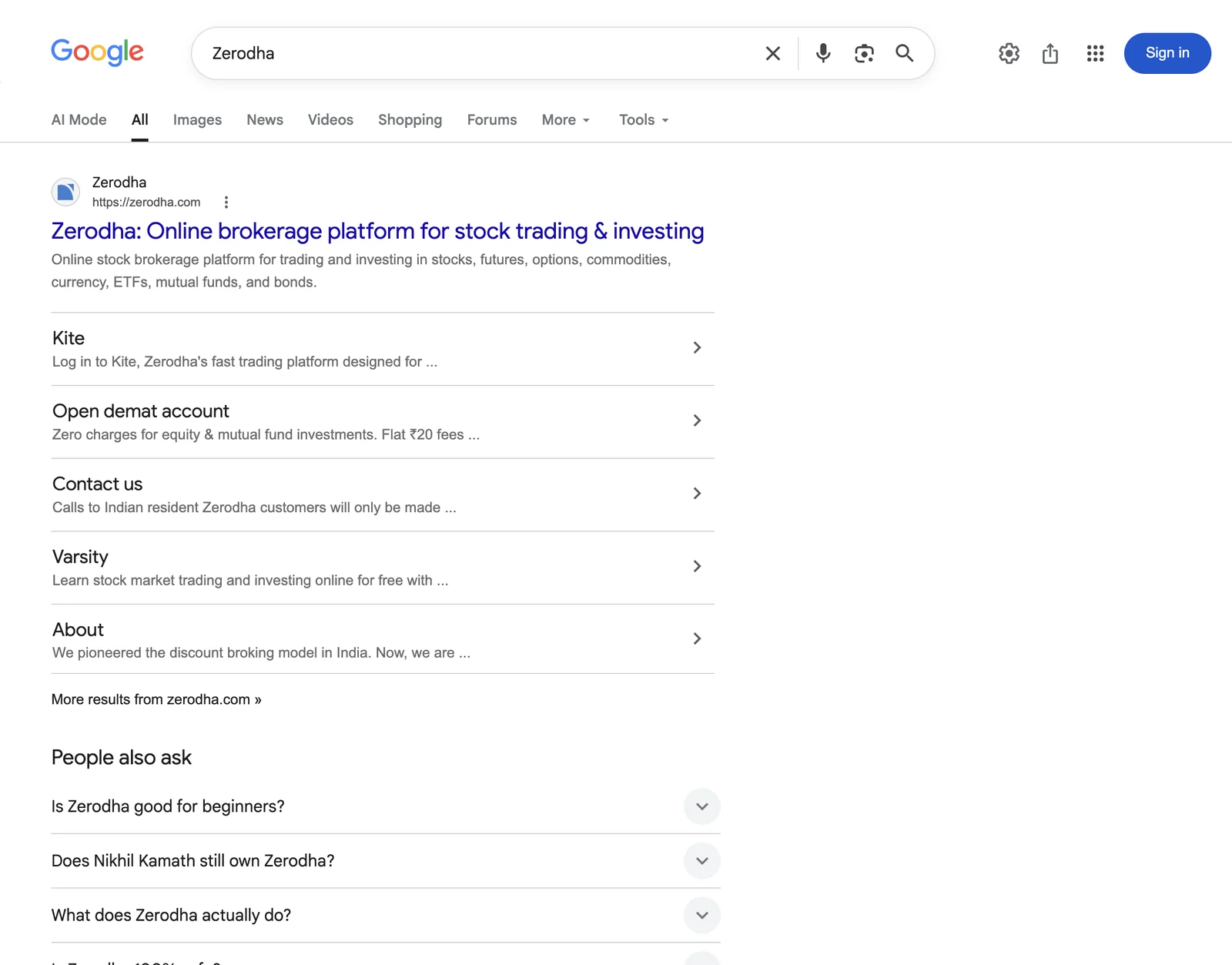
This is the single most useful thing on this page, and it is missing from almost every article on the subject. A panel does not switch on. It arrives in two stages, and the gap between them is where most people conclude the work failed.
- Stage oneThe entity record goes live
Google has resolved your scattered records into one entity and given it an identifier. Search that identifier and a card comes back. Search your bare name and you may still get nothing. This typically lands somewhere between two and five months into a real build.
- The gapNothing visibly changes
The record exists. The assistants can already read it. Your name search looks identical to how it looked in month one. This is where people stop, and stopping here is how the work gets wasted.
- Stage twoThe panel fires on the bare name
Google is now confident enough to show the panel when somebody types just your name. Typically six to twelve months from a standing start, longer on a contested name, and no date can be promised.
We publish four of our own records that are sitting at stage one right now, alongside four at stage two. Showing only the finished ones would make a better advert and a worse argument, and anybody in this field showing you nothing but finished panels is either very selective or very new.
Source: Our own eight client records, read live from Google on 31 August 2026
04What it is actually worth, without the marketing
The honest business case is not the box. The box is a visible symptom. The thing worth paying for is the underlying record, and it is worth paying for because of something that changed in the last two years.
Until recently, being findable meant ranking. Somebody searched, got ten blue links, and clicked. Now two things happen instead. Google increasingly answers the question directly, drawing on entities it holds rather than on pages it ranks. And a growing share of the same questions never reach Google at all, because they are asked of an assistant.
Both of those read from the same kind of source: crawlable, attributable, third-party text about you. The Knowledge Panel and the assistant answer are two outputs of one input. That is the real argument, and it is a better argument than the box.
Source: Ahrefs, 863,000 keyword SERPs and 4 million AI Overview URLs
You are not buying a box on a search page. You are buying the thing that answers when you are not in the room.
There is a second, less obvious value, and founders tend to feel it before they can name it. A panel is a disambiguation device. If you share a name with a cricketer, an academic and a man who was arrested in 2019, the panel is the mechanism by which Google tells the world which one you are. For anyone with a common name, that is worth more than the prestige.
05What it does not do, stated plainly
Four things it will not do. We would rather you read these now than discover them in month seven.
What a panel will not fix
- A reputation problem. It makes you easier to find, including the parts you would rather nobody found.
- A weak underlying record. The panel reflects the record. It cannot exceed it.
- Lead generation on its own. Nobody has ever bought a service because a box appeared.
- A namesake collision, automatically. Sometimes the collision is exactly what stops the panel.
What it does do
- Settles who you are when several people share your name
- Gives Google and the assistants a consistent source to answer from
- Puts a photo and a correct one-line description in the highest-attention space on the page
- Compounds, because the record underneath it keeps working after you stop paying anyone
On schema, since it gets sold as an AI product. Ship structured data, because it earns rich results and makes your records machine-readable. Do not buy it as an AI visibility deliverable. A controlled study of 1,885 pages that added JSON-LD against 4,000 control pages found AI Overview citations went down 4.6 percent. The reason people believe otherwise is that 53 percent of AI-cited pages carry schema, which is correlation: competent sites do many things right at once.
Source: Ahrefs, 1,885 pages that added JSON-LD against 4,000 controls, four methods
06Who actually gets one
Google does not publish an eligibility list, which means everything written on this subject is inference from observation. Here is ours, from the builds we have run and the ones we have declined.
- You can name three things you have done that a stranger could verify without your help
- Somebody not on your payroll has written about or interviewed you in the last two years
- There is a domain with your name on it, or you are willing to buy one
- You will sit for content: podcasts, talks, written pieces, five hours a month
- You have one Google account you will still control in five years
If four or five of those are true, a build is a reasonable purchase. If two or fewer are true, the honest answer is that you are not buying a Knowledge Panel, you are buying the eighteen months of public work that has to happen first, and you should decide whether you want that on its own terms.
07What it costs
Three honest routes, and the cheapest one is genuinely viable for a lot of people.
| Route | Money | Your hours, year one | Best for |
|---|---|---|---|
| Do all of it yourself | Nothing but a domain | About 110 | Anyone whose opportunity cost is under roughly $80 an hour, and who can keep four hours a week for a year |
| Hybrid: keep the thinking, buy the execution | Partial engagement | About 35 | Most founders. You keep steps one, two, six and ten because you have to anyway, and buy the pure-execution steps |
| Full build | $3,000 flat, half at intake | About 35 | People whose weeks are the expensive part, or who have a namesake collision that needs untangling first |
Notice that the hours column barely moves between hybrid and full. That is not a pricing trick, it is the shape of the work. About thirty-five hours are structurally yours: deciding your identity, sitting for the content, holding the Google account, and submitting the claim with your own documents. Nobody can take those, and anybody offering to take the last one is asking for papers nobody should hand over.
On the paid build specifically: half at intake, half the day there is an entity identifier or a live card to show you. No monthly retainer and no upsell ladder. Four builds run at a time, because the part that takes the months is third-party corroboration and that cannot be parallelised by hiring more people.
08The build order, and why the order matters
Twelve steps. The sequence is not decorative: each step assumes the previous one is true, and skipping is the most common reason a build stalls at month five with nothing to show. The full mechanics live on the companion manual; this is the shape.
Source: Our own eight client records, read live from Google on 31 August 2026
- Decide the identity. Three sentences: who you are, what you stand for, what result you drive and for whom. Plain language. If these cannot be answered, nothing downstream has anything to broadcast.
- Build the brand brain. One private file holding every fact anyone will state about you: bios at four lengths, dates, registrations, the master headshot, transcripts, case studies with names and results.
- Stand up the entity home. One site on your own name, separate from the company site and linked both ways, with the identity line as the first paragraph in plain text and the headshot above the fold.
- Ship the schema. Person on the personal site, Organization on the company site, wired to each other. This is the machine-readable layer you fully control.
- Align every profile. Same name string, same headshot file, same first eight words of headline, same city, same first bio line, one link format. Two unglamorous hours with the highest return in the project.
- Instrument it. Search Console verified on an account you will still control in five years, because the same account is needed for the claim and every future edit.
- Manufacture real proof. Two cornerstone pieces a month, one case study, weekly clips. Published to your own site first, then mirrored outward.
- Densify the cross. Independent witnesses at the intersection of your trade and your city. Three to five of each. This is the part that takes months and the part that cannot be faked.
- Add the accelerators. Authorship with an ISBN first, then Wikidata only if the notability bar is honestly cleared, then peer proximity through podcasts.
- Claim it. When the panel appears, you claim it, from your own account, with your own documents.
- Lock the entity. Panel appears on brand-only queries, verified edits land in days, off-brand images are gone, you consistently beat namesakes.
- Run the cadence forever. Weekly review, monthly assistant baseline, quarterly audit. Drift is silent and it is the enemy.
09The geo-vertical cross, which is where the months go
If you take one structural idea from this page, take this one. Independent corroboration has two axes, and the value is at the intersection rather than on either axis alone.
The vertical axis is your trade: peers, suppliers, associations, conferences, industry podcasts. The geographic axis is your place: local press, chambers, allied trades, charities, civic bodies. A person who is named by five people in their trade looks like somebody with a good publicist. A person named by five in their trade and five in their city looks like somebody who actually exists and actually does the thing.
That second pattern is the one spammers do not bother to fake, because faking it is more expensive than earning it. Which is precisely why it works.
One India-specific caveat, since most of our clients are here. The standard playbook for this step is written for American local-service businesses, where chambers of commerce, city journals and local press all publish crawlable pages. In India that geographic layer is much thinner online. The substitution set is different: industry associations, trade bodies, regional business press, university and conference pages, and Indian-language publications that Google crawls but most agencies ignore.
10The claim, and the field that gets people rejected
When a panel appears, claiming it takes about ten minutes and one field decides the outcome. The field asks why you are claiming the panel. Almost everybody answers the wrong question.
Answers that get rejected
- I am the subject of this panel and I would like to manage it
- This is my personal brand and I want to control what it says
- I am a public figure and this panel represents me
- A long paragraph about who you are with nothing checkable in it
Answers that get approved
- A statement naming the specific records already in Google's index that identify you
- Links to the entity home, the author archive, and the coverage that names you
- The identity line, verbatim, matching what those records already say
- Short. Three or four sentences of evidence, not of introduction
One hard line, and it is not negotiable. The claim requires identity verification, and that verification is yours. We prepare the packet and rehearse the field. You submit it. We do not take identity documents, we do not store them, and we do not log into your account. Anybody willing to do those things for you is a risk you are hiring.
11Namesakes, and the case where we say no
Namesake collisions are the most under-discussed failure mode in this field, and they are common in India where a shared surname plus a common first name can put several hundred people in the same string.
There is a soft version and a hard version. The soft version is that other people with your name rank above you, which more record fixes. The hard version is a live collision: Google serves a different person's panel for the same query on different days, because it holds two entities it cannot cleanly separate.
We have watched exactly that happen, twenty minutes apart, on somebody we know well. When that is the state, more content makes it worse rather than better, because you are adding weight to a query that is already ambiguous. The fix is a different and longer project, and we will say so before taking money rather than after.
12What we refuse to do
Worth stating, because most of these are on sale somewhere.
- We will not promise a panel, or a date. Google offers no guarantee, no application and no service level, and neither can anyone reselling it.
- We will not write or buy a Wikipedia article. A deleted page leaves a public record of the deletion and leaves you worse off than never trying.
- We will not handle your identity documents or log into your Google account.
- We will not quote the Knowledge Graph match score as a Google trust metric. It is a query-relative relevance number and treating it as a confidence rating is the most common piece of misinformation in this field.
- We will not take the engagement if the entity is not ready. Refusing a doomed build is cheaper for both of us than a refund in month eighteen.
| Claim you will hear elsewhere | What the evidence actually says |
|---|---|
| Schema markup gets you cited by AI | A controlled study found AI Overviews -4.6% after adding JSON-LD. Ship schema for rich results, never bill it as AI visibility. |
| 76% of AI Overview citations come from the top 10 | Superseded. The figure is 37.9%, from a sample roughly twice the size. |
| Write a listicle putting yourself first | When a brand's own listicle was cited, the brand was left out of the recommendation 69% of the time. |
| Longer articles get cited more | Correlation between word count and citation is 0.04. Over half of cited pages are under 1,000 words. |
| A knowledge panel takes 90 days | Our build window is 60 to 90 days. The panel tends to fire on the bare name at 6 to 12 months. |
13Our own record
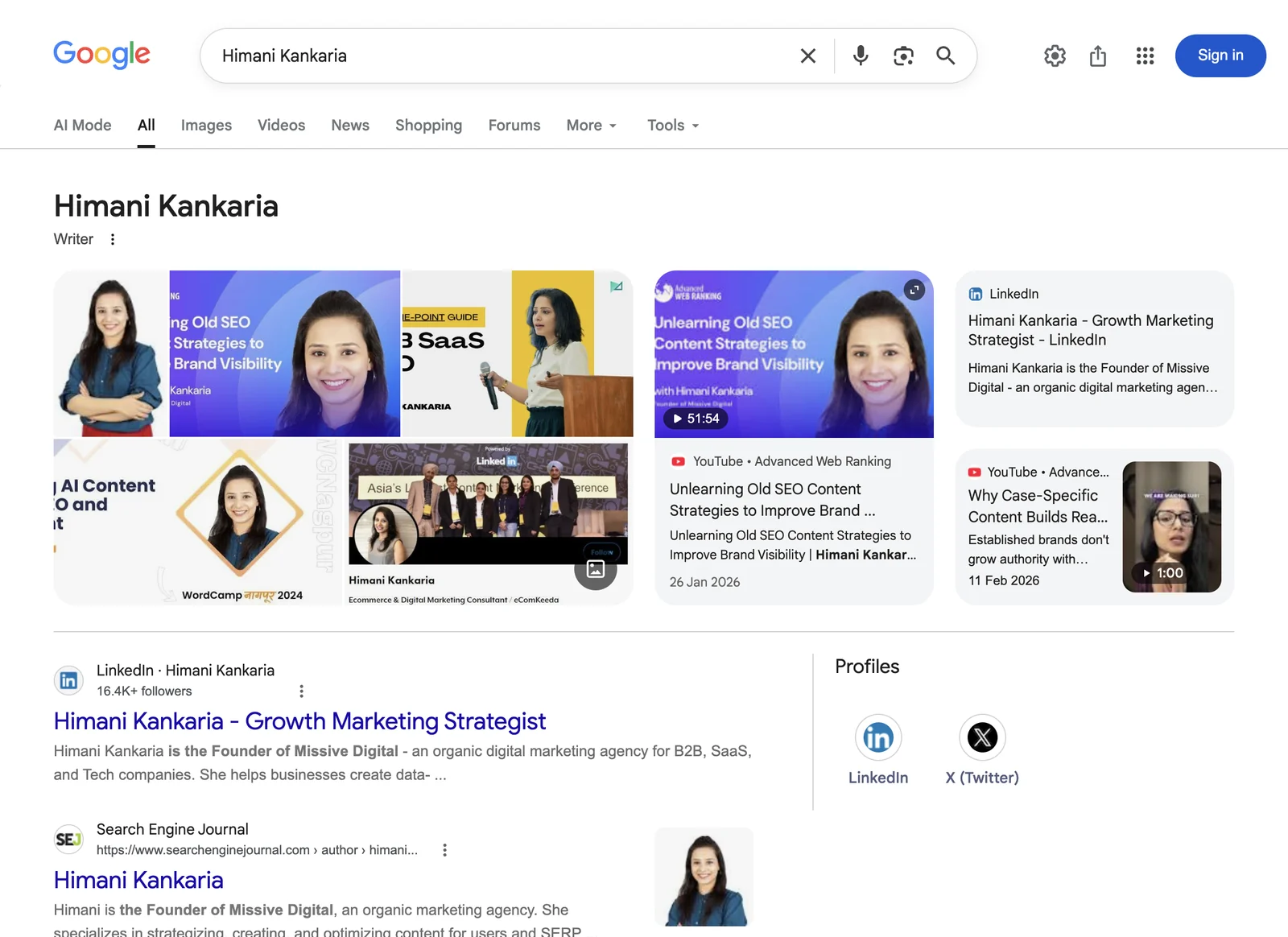
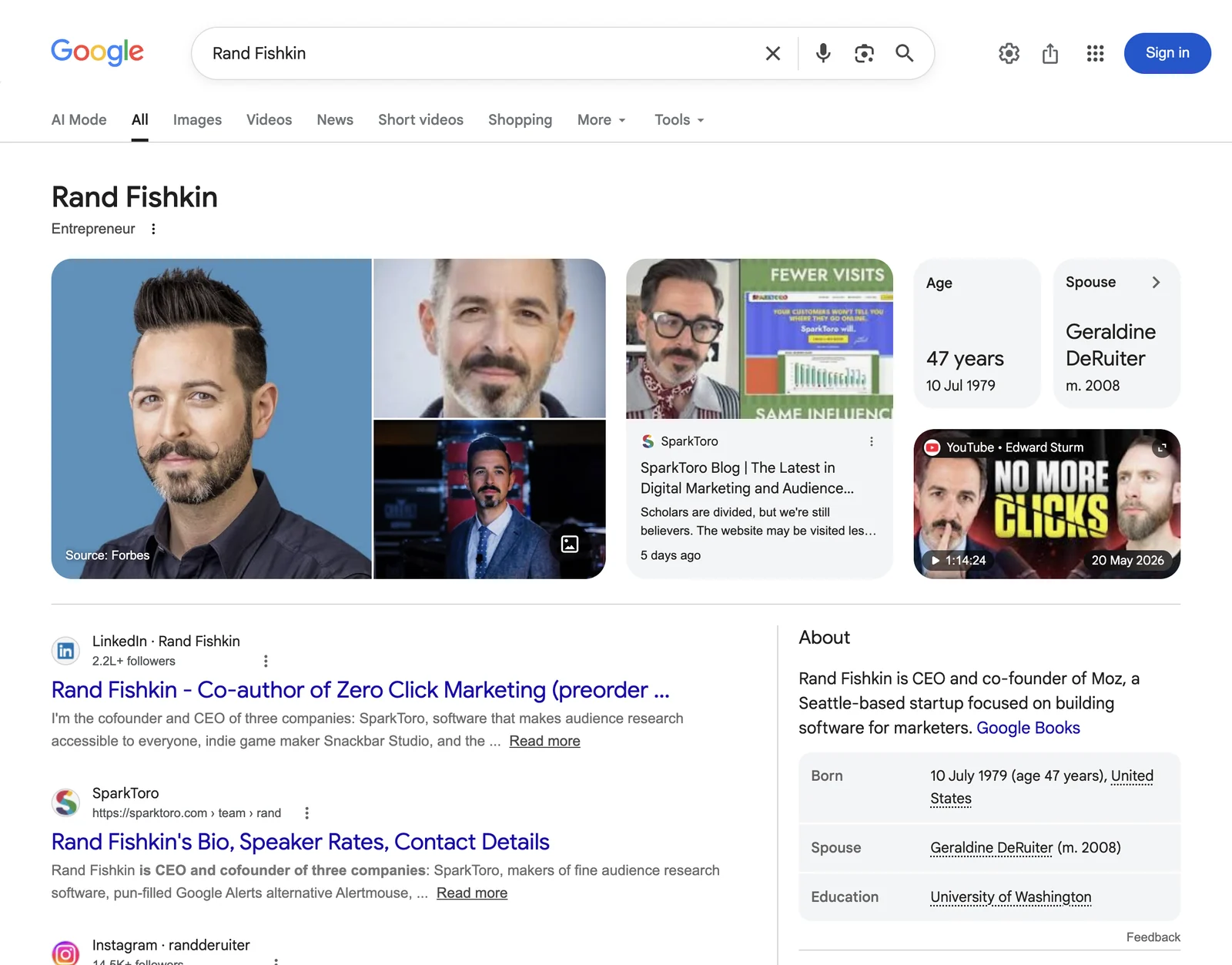
Eight records, four at stage two and four at stage one, every one of them a real person you can look up right now. The stage-one four are published deliberately.
| Name | Entity ID | Stage reached |
|---|---|---|
| Sandeep Tiku | /g/11n88rs3s0 | Stage 2 — panel fires on the bare name |
| Harsh Pamnani | /g/11f0z6v3zr | Stage 2 — panel fires on the bare name |
| Rohit Bassi | /g/11gbh01wq4 | Stage 2 — panel fires on the bare name |
| Wanuri Kahiu | /m/09gps9j | Stage 2 — worked on, not built |
| Himani Kankaria | /g/11rggfbxt1 | Stage 1 — entity record live |
| Katerina Khramova | /g/11f0zrgtrz | Stage 1 — entity record live |
| Sagar Kathrotiya | /g/11ld4h_jsy | Stage 1 — entity record live |
| Ramesh Pattni | /g/11kpwvj02p | Stage 1 — entity record live |
One of the eight is labelled worked on rather than built, because that person already had a partial record when we started and claiming otherwise would be a lie that is easy to check. One further client is deliberately excluded from this table: his entity is in a live namesake collision with an academic of the same name, and unstable proof is not proof.
14The nine diagnostic queries
Before you buy anything from anyone, run these. They take twenty minutes in a private window and they tell you which of three completely different problems you have. Most people who think they need a Knowledge Panel build actually have problem two, which is cheaper and faster to fix.
| # | The query | What a bad result tells you |
|---|---|---|
| 1 | Your full name | The headline test. If page one is not mostly you, everything downstream is harder. |
| 2 | Your name plus your city | Fails when the geographic half of your record is missing. Remote-first people fail this constantly. |
| 3 | Your name plus your role | Fails when your job title is written four different ways across your profiles. |
| 4 | Your name plus your company | Fails when the person and the organisation are not connected in a way a machine can read. |
| 5 | Your name plus your strongest topic | Fails when you publish a lot and none of it is attributed to you in a machine-readable way. |
| 6 | Your name plus your second topic | The same test again. Two topics passing is a category signal; one is a coincidence. |
| 7 | Your name in quotes | Shows how many distinct people share the exact string. This is the namesake count. |
| 8 | Your name plus the strongest namesake's field | Tells you whether Google is currently blending you with somebody else. |
| 9 | Your name, in Google Images | Fails when the wrong face comes back, which is the single most alarming result on this list. |
Score it honestly: how many of the nine return results that are about you, accurate, and that you would be happy for a client to read. Under four and the record genuinely needs building. Four to seven and you probably have a correction job rather than a construction job. Eight or nine and you should be claiming a panel rather than commissioning one.
15The assistants are now the same problem
Two years ago this page would have been about Google alone. It is not any more, and the reason is worth understanding because it changes what you are buying.
When somebody asks an assistant who the best person is for a given problem, the model is not checking your engagement rate or your follower count. It is drawing on text about you that exists in crawlable, quotable, attributable form. A LinkedIn post is a poor source for that. A published interview on a domain with a history is an excellent one.
Which means the Knowledge Panel work and the assistant-visibility work are not two products. They are one input with two outputs. Anybody selling them to you as separate line items is either confused or counting on you being.
Source: Ahrefs Brand Radar, 1.9 to 4 million queries per platform, read 25 Aug 2026
Two readings of that chart that matter for how you spend. First, social and user-generated surfaces dominate almost everywhere, so material that lives only on your own site earns very little citation share. Second, and this surprises people: the New York Times sits 35th on AI Overviews at 0.4 percent mention share. A tier-one press placement bought specifically for AI visibility is buying prestige rather than citations. It may still be worth buying. Just not for that reason.
16How to compare us against anyone else
You should get other quotes. Here is what to ask them, and what the answers tell you. These are the questions we would want asked of us.
- Ask them to guarantee a panel. If they will, walk. Google offers no application, no guarantee and no service level, so a guarantee of the outcome is either ignorance or a sales tactic. A guarantee of a refund is a different and legitimate thing.
- Ask what the Confidence Score means. If they present it as a Google trust metric, they have read a blog post rather than the documentation. It is
resultScorefrom the Knowledge Graph API and it is query-relative: it measures how well an entity matched the string you typed, not how much Google trusts the entity. - Ask whether they will write your Wikipedia article. If yes, walk. A deleted article leaves a public deletion record and leaves you materially worse off than never trying.
- Ask whether they need your ID documents or your Google login. If yes, walk. The claim is the owner's own hands, always, and there is no version of this work that requires handing over identity papers.
- Ask to see a client whose panel has not fired yet. If every case study is a finished panel, they are either very selective about what they publish or very new. Most of this work, most of the time, looks like a stage-one record.
- Ask what happens in month six if it is not working. The right answer involves changing the corroboration strategy or stopping, not publishing more.
We publish four unfinished records for exactly this reason. It is a worse advert and a better argument, and if a competitor will not do the same, that tells you something.
17A real twelve months, month by month
What an engagement actually feels like from the inside, including the two months where it feels like nothing is happening, because those are the months people quit.
- Month 0The verdict
We run the nine queries, the Knowledge Graph lookup, the namesake count and a three-assistant baseline before you pay past the deposit. If it comes back saying wait, we say wait and you keep the rest.
- Months 1-2Identity and the home
The three sentences, the brand brain, the entity home, the schema. This is the part that feels like progress, because things visibly appear.
- Months 2-4Alignment and instrumentation
Every profile made to agree. Search Console verified. Unglamorous, fast, and the highest-return work in the whole engagement.
- Months 3-6The quiet part
Witness work. Asking, waiting, following up, waiting. Nothing visible changes on your name search. This is where people conclude it failed, and it is where the outcome is actually being built.
- Months 4-8Stage one
An entity identifier appears. Search it and a card comes back. Search your bare name and it may still be nothing. This is the milestone, and it does not look like one.
- Months 6-12Stage two, usually
The panel starts firing on the bare name. Sometimes it flickers first, appearing on some searches and not others, which is normal and resolves as the record thickens.
- Month 12Claim and hand over
You claim it from your own account. We hand over the brand brain, the cadence and the measurement set, and you can run it yourself from there.
The two months in the middle are the honest reason this is a twelve-month engagement rather than a ninety-day one. If somebody tells you a panel in ninety days, they are either describing the stage-one record and calling it a panel, or they are describing something that did not happen.
18What arrives in week zero, before you commit
The first thing we send is a verdict, not a proposal, and it arrives before you have paid anything past a deposit. It is deliberately the part of the engagement most likely to lose us the sale.
- The nine diagnostic queries, run signed out, with screenshots and a score out of nine
- The Knowledge Graph lookup: whether an entity already exists for your name, and its identifier if so
- The namesake count, and whether any of them is a live collision rather than an ordinary competitor
- A three-assistant baseline: nine prompts across ChatGPT, Claude and Perplexity, scored, dated, saved
- A route: full build, correction job, or wait, with the reasoning written down rather than asserted
- If the answer is wait, what specifically would have to change for it to become go
About a third of the time the honest route is not the full build. Sometimes an entity already exists and the job is correction, which is shorter and cheaper. Sometimes there is a live namesake collision and the correct advice is to solve that first. Occasionally the honest answer is that the underlying record is too thin and the money is better spent on the eighteen months of public work that has to happen anyway.
We would rather say that in week zero than in month seven. It is also the cheapest possible test of whether the person you are talking to is selling a method or selling hope, and you should apply it to everyone you speak to, including us.
19What happens if you do nothing
A fair question, and the honest answer is: for many people, not much, for a while. Then two things tend to happen at once.
The first is that somebody else with your name builds a record and takes the query. This is not hypothetical and it is not reversible on a short timescale. Entities consolidate, and the one with the deeper record wins the bare name.
The second is that assistants start answering the category questions in your field, and they answer from sources that do not include you. Being absent from those answers is not neutral, because the answer still gets given. It just names somebody else.
The question is not whether an answer about you exists. It does. The question is whether you had any part in building it.
20What a namesake collision actually costs
Worth its own section, because it is the one situation where the standard advice is actively wrong and where we most often tell people not to buy.
The ordinary version is that other people share your name and some of them rank above you. That is a volume problem and more record fixes it. It is annoying and it is not dangerous.
The dangerous version is a live entity collision. Google holds two entities it cannot cleanly separate and serves one or the other depending on the query, the day, and the data centre. We have watched Google serve two different people's panels for the same name twenty minutes apart. When that is the state, publishing more about yourself adds weight to an already ambiguous query and can make the blending worse rather than better.
| What you see | Which version it is | What to do |
|---|---|---|
| Other people with your name rank above you | Ordinary | Build the record. This resolves with time. |
| A panel appears for your name, showing somebody else | Live collision | Stop publishing. Disambiguate first. |
| The panel changes between searches on different days | Live collision, unstable | Escalate. This is its own project. |
| Your name plus your city works, bare name does not | Ordinary, stage one | Keep going. This is the expected middle state. |
| Google Images returns the wrong face | Alignment problem, not a collision | Fix the master headshot everywhere. Cheap and fast. |
The distinction matters commercially. The ordinary version is a normal build. The live collision version is longer, less predictable, and we will say so before taking money rather than discovering it together in month seven. One of our own clients is deliberately excluded from the published record for exactly this reason.
21How to start
Do not start by buying anything, including from us. Start with the ninety-second diagnosis, because it changes which of three routes you are on and one of the three is much cheaper than this page.
- Search your full name in a private window. Screenshot page one. Note whether a panel appears and whether the results are about you.
- Look your name up in Google's Knowledge Graph. If an identifier comes back, you already have an entity and your job is correction, not construction, which is a shorter and cheaper job.
- Ask ChatGPT, Claude and Perplexity who you are and what you are known for. Save the answers with today's date.
- Route yourself honestly. Clean panel showing means claim it this week and stop reading. Wobbly or wrong panel means fix the record. Nothing at all means a full build, and ninety days is the floor before anything is visible.
- If you are doing it yourself, the day-by-day calendar and the copy-paste toolkit are both free and linked below. If you want it built, the intake is an email, not a form.
Either way, re-run step one in ninety days with the same wording. The delta is the only measurement in this whole field that means anything, and almost nobody has a baseline to compare against.
Flat, for the twelve-month build. Half at intake, half the day there is an entity identifier or a live card to show you. No retainer, no monthly, no upsell ladder. Full refund if nothing is live at twelve months.
What to remember
- A Knowledge Panel cannot be bought or applied for. It is a confidence output, not a reward.
- It arrives in two stages, and the gap between them is where most people wrongly conclude the work failed.
- The real purchase is the record underneath, because Google and the assistants read the same one.
- Six to twelve months is the honest range on a strong entity. Nobody can promise a date.
- About 35 hours stay yours no matter which route you pick, and the claim is one of them.
- Start with the ninety-second diagnosis, because one of the three routes it points to is nearly free.
Questions people actually ask
How much does a Google Knowledge Panel cost?
Nothing, in the sense that Google charges no fee and takes no application. What costs money is building the public record that makes one likely. Our full build is $3,000 flat for twelve months, half at intake and half when there is an entity identifier or a live card to show. Doing the same work yourself costs about 110 hours in the first year and no money beyond a domain.
How long does it take?
On a genuinely strong entity, six to twelve months before the panel fires reliably on the bare name. An entity record often appears earlier, between two and five months, and answers on its own identifier. On a common or contested name it takes longer. Anybody quoting you a specific date is guessing, and we would rather say that than sell certainty we do not have.
Can you guarantee I will get one?
No, and neither can anyone else. Google offers no guarantee, no application route and no service level agreement for Knowledge Panels. What we guarantee is the work and a full refund if nothing is live at twelve months. That is a commercial promise about our own conduct, not a promise about Google's behaviour, and the distinction is the whole point.
Do I need a Wikipedia page?
No. Wikipedia helps when it exists on its own merits, and actively hurts when it is attempted early: a deleted article leaves a public deletion record and leaves you worse off than never trying. Wikidata is a separate and much lower bar, and it is worth doing once the notability question has an honest yes. We do not write, buy or place Wikipedia articles.
What is the difference between a Knowledge Panel and a Google Business Profile?
A Business Profile is about a place: hours, directions, reviews, a map. A Knowledge Panel is about an entity, usually a person or an organisation, and it draws from the Knowledge Graph rather than from a listing you fill in. You claim them through different routes and they answer different queries. Having one does not produce the other.
My panel shows the wrong photo or the wrong description. Can that be fixed?
Yes, and it is a much shorter job than building from nothing. Once the panel is claimed you can suggest edits, which Google reviews rather than applies. The description line is the hardest to move, because it is assembled from what the web says about you, so the reliable fix is to change what the web says rather than to keep resubmitting the edit.
Someone else comes up when people search my name. What do I do?
First work out which version of the problem you have. If other people with your name simply rank above you, more record fixes it. If Google is serving a different person's panel for your name, sometimes inconsistently between searches, that is a live entity collision and adding content makes it worse. That case needs a different plan, and it is the one situation where we routinely tell people to wait.
Does schema markup get me a panel, or get me cited by AI?
It helps with the first and does not help with the second, and the second is widely mis-sold. Structured data is how a machine learns that six URLs are one person, so ship it. But a controlled study of 1,885 pages that added JSON-LD against 4,000 controls found AI Overview citations fell 4.6 percent. Never buy schema as an AI visibility product.
Will this get me leads?
Not directly, and we would be careful with anyone who says it will. What it changes is the ninety seconds after somebody already interested in you types your name. That moment sits in the middle of deals you are already in rather than at the top of a funnel, which is why the effect shows up as fewer lost deals rather than more new ones, and why it is genuinely hard to attribute.
What if I already have a panel?
Then skip most of this page. Claim it this week if it is unclaimed, read every line of it for errors, and set a quarterly reminder to re-check. A claimed panel that nobody looks at for two years drifts, and the drift is silent until a client mentions it.
Can I do this myself?
Yes, genuinely, and for a lot of people you should. Nobody has a back channel to Google, so the work is the work. The whole method is published free: a day-by-day calendar and a copy-paste toolkit, both linked from this page. The honest breakeven is your own opportunity cost, at roughly $80 an hour.
Why do you publish clients who have not got a panel yet?
Because showing only finished work would make a better advert and a much worse argument. Four of our eight records are at stage one, meaning the entity is live and the panel has not fired on the bare name. That is what most of this work looks like most of the time, and anyone showing you nothing but finished panels is either very selective or very new.