A guide for solopreneurs and one-person businesses
Personal branding for solopreneurs: six jobs, in order.
When you work alone, your name is the company. A client hears it, searches it, and makes up their mind before your first call.
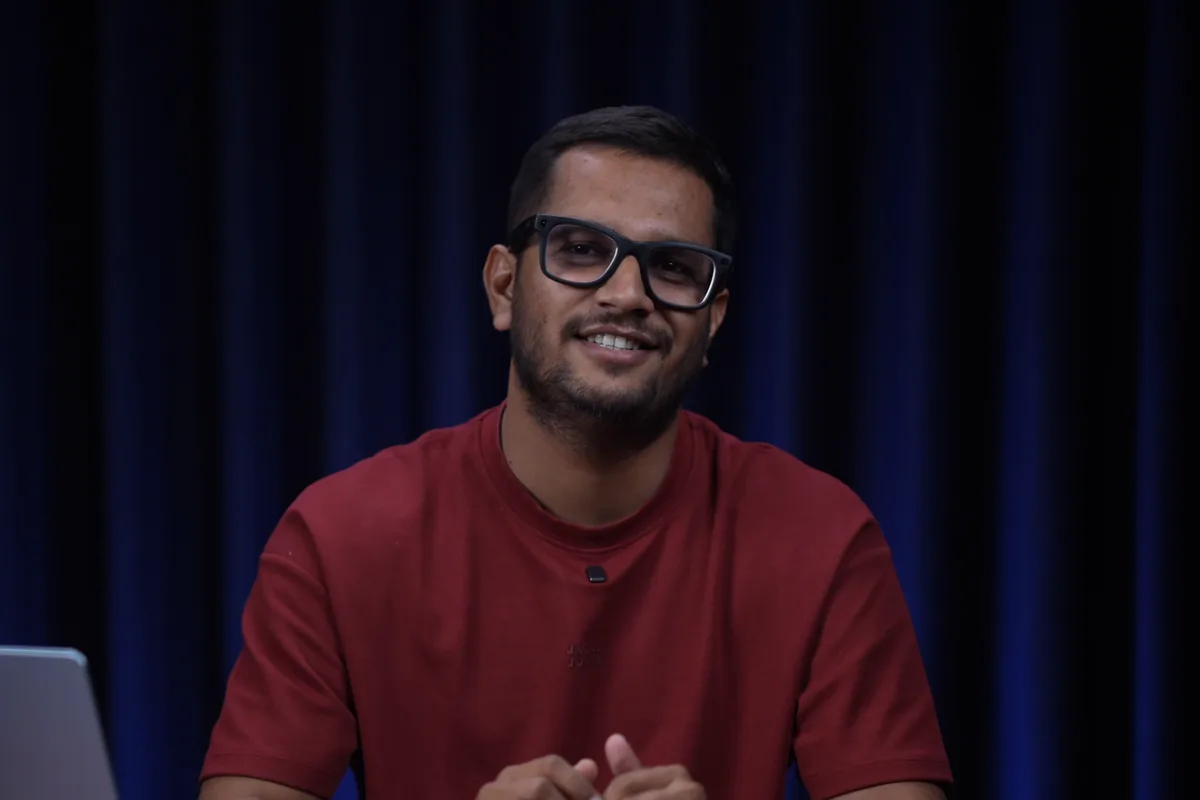
I'm Bhavik Sarkhedi. I built and sold three companies, the largest with a team of 75, and today I work on my own. This is the order I would do the work in if I were starting again as a solopreneur.
Featured in


The short answer
What personal branding means when the business is you.
Personal branding for solopreneurs is the work of making your name return the right answer wherever a client looks you up: Google, AI Overviews, ChatGPT and LinkedIn. In a company, a sales team, a brochure and a reference call do that job. In a one-person business, your search results do it.
That takes two skills that are usually sold apart, so I gave the result its own name.
Where the name comes from
Personal Branding Search Engine Optimization Person Engine Optimization
Have you done yours?
Check your name in 60 seconds| Question | A company with a team | A solopreneur |
|---|---|---|
| What the client searches | The company name | Your name |
| Who answers the first doubt | A salesperson | Your search results and your profile |
| Where the proof sits | Case study pages and a client list | Named clients, testimonials and press, on pages you control |
| When the offer changes | The company name stays and the team adapts | Your name carries over to the new offer |
| Who keeps it current | A marketing team | You, so the routine has to stay small |
The order
Six jobs, in the order I'd do them.
Most advice for solopreneurs and small business owners starts with posting every day. I'd start with the two things a client sees first, your line and your home page, because every post you publish afterwards sends people to them.
- 01
Write one line that says who you help and what changes for them.
Until this line exists, every profile says something different and nobody can repeat what you do. Mine reads: I help your personal brand appear everywhere online. Use words a client would say out loud, and put the same line on every profile you own.
- 02
Give your name one home page.
Choose the page you want Google and AI assistants to treat as the source on you. A site on your own name works best, with an about page that states your line, your work history, your proof and links to your real profiles. Every other profile links back to it.
What comes up when someone Googles you - 03
Make every profile say the same thing.
LinkedIn, X, your directory listings and your author bios should carry the same name, the same line, the same photo and the same link. Search engines and AI assistants compare these pages. When they agree, your name gets one clear answer. When they disagree, the answer comes out muddled.
How I set up a LinkedIn profile - 04
Put your proof where a stranger can check it.
List the clients who allow it, publish testimonials with full names, and link every press mention to its source. A solopreneur has no company name to borrow trust from, so proof that can be checked does that work.
My own proof: every place I have been featured - 05
Publish once a week, from real work.
Choose the one platform your clients read and write about work you did that week: the problem, what you tried, what happened. One post from real work does more for your name than five written to fill a calendar. For most solopreneurs who sell to other businesses, that platform is LinkedIn.
LinkedIn personal branding for founders - 06
Get named on pages you don't own.
Podcast interviews, guest articles, journalist requests and client case studies put your name on other people's pages. It is the slowest of the six jobs and the one that counts most for AI answers, as the study below shows. One appearance a month is a realistic pace when you work alone.
How founders actually get media coverage
Nobody can promise you a ranking, a Google Knowledge Panel or a place in an AI answer. These six jobs make every page you control say the right thing, and they give other people reasons to name you.
| Job | How often | You know it is done when |
|---|---|---|
| 1. Your line | Once, then a review every six months | A client can repeat it after one read |
| 2. Your home page | Once, then whenever your work changes | It appears when you search your own name |
| 3. Matching profiles | Once, then a check every quarter | Every profile shows the same line, photo and link |
| 4. Proof | Each time a project ends | A stranger can verify three results without contacting you |
| 5. A weekly post | Every week | You have published four weeks in a row |
| 6. Being named elsewhere | Every month | A search for your name shows pages you didn't write |
The evidence
Why being named elsewhere counts most for AI answers.
In May 2025 Ahrefs studied about 75,000 brands to see what goes together with being named in Google's AI Overviews. Mentions of the brand across the web had the strongest link of any factor they measured, at 0.664. The number of backlinks scored 0.218.
Average mentions in Google's AI Overviews
People in my business
What the six jobs add up to.
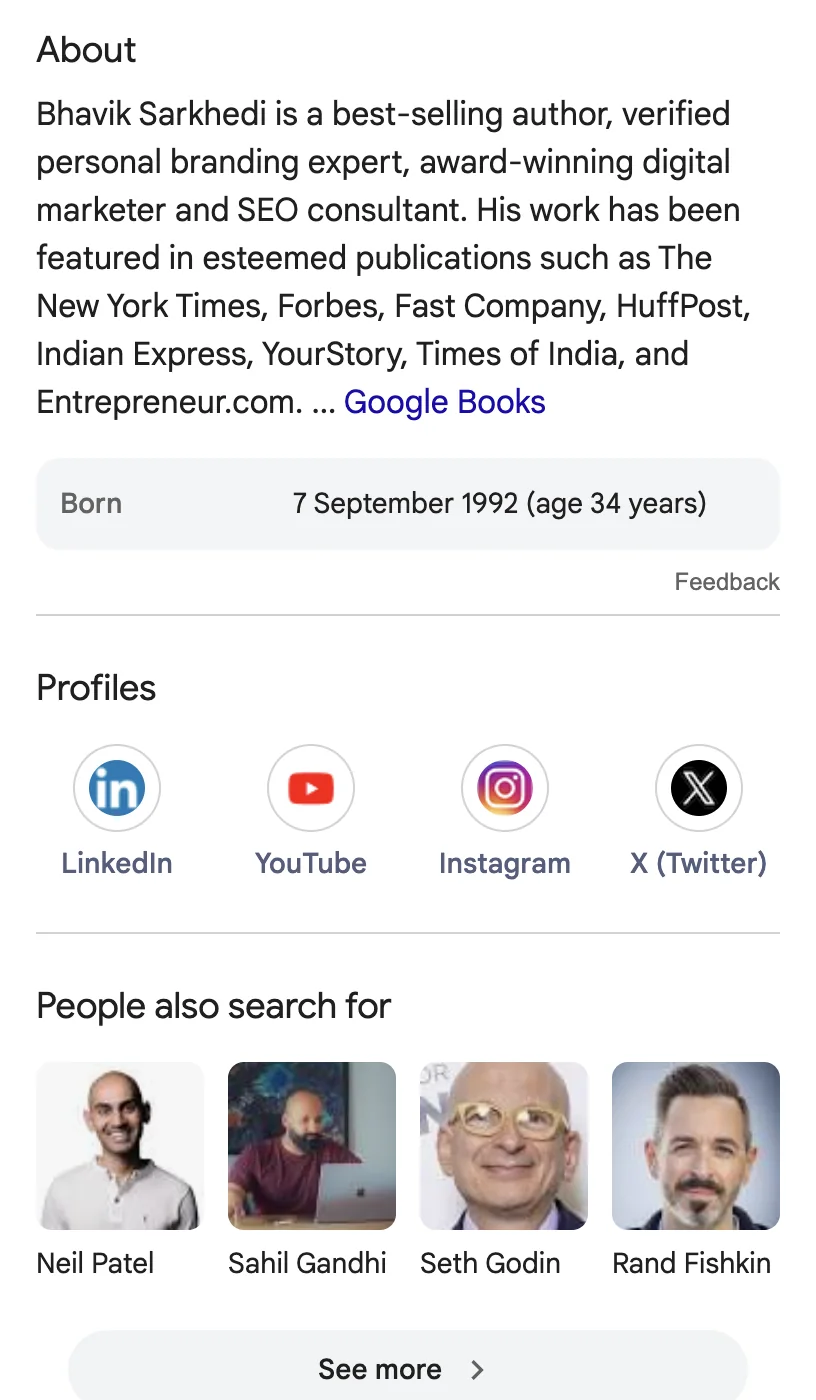
This is what Google shows when you search my name. It is built from pages that agree with each other, which is job three, and from pages I didn't write, which is job six.
For a solopreneur the practical reading of the study is simple: time spent getting your name onto good pages you don't own is time well spent.
The second chart is my own record. I have built teams of two and a team of 75, and the same personal brand carried through every change. That is the strongest reason I know for a solopreneur to build one: it stays with you when the business changes.
Free, 60 seconds, no sign-up
How does your name look online? Check it in 60 seconds.
Before you start on the six jobs, look yourself up the way a client would. Tick what is true, and the check tells you which job to do first.
1 Type your name, then look yourself up the way a client would.
Each opens in a new tab with your name already typed in.
3 Your result
Tick the ones that are true. Be honest, nobody else sees this.
Start with your own website on your name. It is the one page you fully control and the one every other mention can point back to.
Opens your email with your score written in. Nothing is saved on this page.
With AI
What AI changes for a one-person business.
Clients now ask ChatGPT, Gemini and Google's AI Overviews who to hire. Those answers are assembled from pages across the web, so the six jobs above are also how you get named there.
AI also changes how much one person can do. I research, draft and check with Claude every day, and I still write the final line myself. I work as an AI personal branding expert for founders, and that page explains which parts I hand to AI and which parts stay with people.
If the business is you alone, the brand work and the daily operations feed each other. Solo Not Small is where I teach the systems behind a one-person business, so you can scale with AI and keep your name on the work.
What to skip
Five mistakes I see solopreneurs make.
Posting every day before the line is settled.
More posts only repeat an unclear message to more people. Settle the line first.
A different bio on every profile.
Each version weakens the others. Copy one line everywhere.
Proof nobody can check.
"Trusted by 100+ clients" with no names reads as a guess. Three named results beat it.
Building only on platforms you rent.
A feed can change its rules in a week. Your own site stays yours.
Paying for followers or planted mentions.
They bring no clients, and Google's spam systems are built to discount them.
Read next
Every guide I have written on this.
- Personal branding for founders, without the bad advice
- A twelve-month personal branding strategy for a founder
- Eight ways founders waste a personal branding budget
- What personal branding costs, and who to hire
- Personal brand vs company brand: where the line goes
- Thought leadership vs personal branding: not the same job
- Stages and podcasts: which ones are worth your time
- When your search results turn against you
- The honest ROI of executive personal branding
- What investors find when they diligence you
- Building your own Google Knowledge Panel: the real hours
- Google Knowledge Panel: what it is worth
- Personal branding with AI, for founders
- My keynote on person engine optimization
- Scale a one-person business with AI
- Why I started Solo Not Small
- My story, from Jetpur to now
- The books I have written
- AI personal branding, the hybrid way
- The people I have built for
- What clients say about working with me
- The personal branding checklist: 54 things to do
FAQ
Questions people ask me.
What is personal branding for solopreneurs?
It is the work of making your name return the right answer wherever a client looks you up: Google, AI Overviews, ChatGPT and LinkedIn. In a one-person business your name is the brand, so your search results do the job a sales team does in a larger company.
How is it different from branding a company?
A company brand can change its people and keep its name. A solopreneur's brand is one person, so it rests on your line, your proof and your profiles saying the same thing, and it stays with you when your offer changes.
How long does personal branding take for a solopreneur?
Your own pages and profiles can be put right in a few weeks. Being named on other people's pages and in AI answers usually takes months, because those answers wait for other pages to agree. Nobody can give you a date.
Is LinkedIn enough, or do I need a website too?
Use both. LinkedIn is where most business clients check you first. A site on your own name is the one page you fully control, and it gives Google and AI assistants a clear source for who you are.
Can AI do my personal branding for me?
AI helps me research, draft and check faster, and I use it every day. The facts, the stories and the final wording have to be yours, because clients and search engines both reward what only you could have written.
Do you work with solopreneurs directly?
Yes. Use the Contact me button on this page and I will reply by email. For the systems behind a one-person business, start at solonotsmall.com.